Practical Ways Palm Tree Illustrations Enhance Modern Design Projects
Palm trees carry an unmistakable visual language. They suggest warmth, leisure, coastal environments, and a certain unhurried pace that many brands want to associate with their identity. When a design project calls for this specific botanical element, having access to a well-constructed illustration set can save hours of drafting time and ensure consistency across multiple deliverables. The availability of palm tree artwork in professional vector formats has grown considerably, but not all collections are built with the same attention to structure, editability, and real-world usability. Understanding what separates a genuinely useful asset from a merely decorative one helps creatives make smarter purchasing and licensing decisions.
What the AI EPS Palm Trees Collection Actually Offers
At its core, this is a curated set of palm tree illustrations delivered in industry-standard vector formats. The package includes files in AI (Adobe Illustrator), EPS (Encapsulated PostScript), and JPG formats. This combination covers the primary needs of both vector-based workflows and quick raster placement. The AI and EPS files are fully editable vector assets, meaning every anchor point, curve, and color fill can be accessed and modified. The JPG versions provide ready-to-use imagery for situations where vector editing is unnecessary or where file size needs to be minimal.
The compatibility note is worth paying attention to. These files are designed to work across both Mac and Windows environments, which removes a common friction point in collaborative settings. Design teams often include members on different operating systems, and asset compatibility issues can derail timelines. The inclusion of both AI and EPS formats acknowledges that some users prefer native Illustrator files while others need the broader compatibility that EPS provides for older software versions or alternative vector editing applications.
Structural Organization as a Time-Saving Advantage
One of the more underappreciated qualities in illustration assets is file organization. Opening a vector file only to find dozens of unnamed layers, ungrouped elements, and no logical hierarchy is a familiar frustration for experienced designers. This particular palm trees collection emphasizes a neatly organized file and layer structure. In practical terms, this means each palm tree illustration is likely separated into clearly labeled layers or groups, making it straightforward to isolate individual elements, apply changes, or export specific trees without hunting through nested clipping masks and anonymous paths.
When working under deadlines, this layer of organization translates directly into efficiency. A designer tasked with pulling a single palm silhouette for a website hero image should not need to spend ten minutes deconstructing a file to extract what they need. Well-structured assets respect the user's time and reduce the cognitive load of file navigation. For teams that maintain asset libraries or share files across multiple projects, clean organization also makes it easier for another designer to step in and understand the file's construction without the original creator present.
Detail Consistency and Its Role in Professional Output
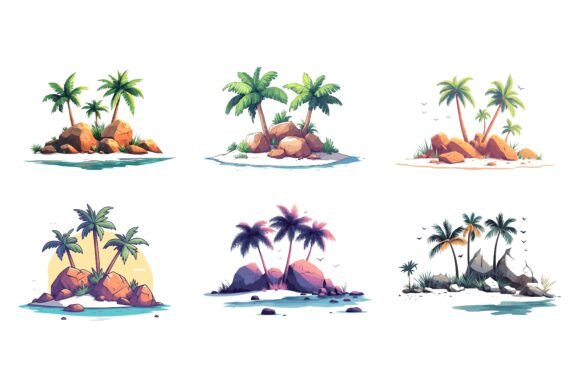
Consistency in illustration sets matters more than many realize. When a collection features multiple palm tree variations, those variations need to feel like they belong to the same visual family. Differences in line weight, shading approach, level of geometric simplification, or color palette can make a set feel disjointed when used across a single project. The claim of perfection in details and consistency suggests that these palm trees maintain a uniform stylistic approach throughout the collection.
This consistency becomes especially important in multi-page layouts, brand identity systems, or any scenario where multiple illustrations appear in proximity. A brochure featuring three different palm tree styles on adjacent pages would undermine the design's cohesion. Consistent detailing also makes it easier to establish and maintain brand guidelines around illustration usage. When every asset in the set behaves predictably, scaling, color replacement, and stylistic adaptation become repeatable processes rather than case-by-case problem solving.
Versatility Across Print, Web, and Application Design
The versatility of a vector-based palm tree illustration set extends well beyond simple placement in a document. These assets are positioned as suitable for print, web, symbols, apps, and infographics. This breadth reflects the fundamental advantage of vector artwork: resolution independence. The same palm tree that appears at two inches wide on a business card can scale to twenty feet on a trade show banner without any degradation in quality.
For web and app interfaces, palm tree illustrations can serve as loading screen elements, category icons, background motifs, or decorative accents within cards and modals. In infographics, they might appear as data point markers, section dividers, or atmospheric elements that reinforce a tropical or coastal theme. Print applications include everything from event invitations and menus to product packaging and editorial layouts. The ability to repurpose a single asset across such different contexts multiplies its value considerably.
Symbol and icon usage deserves particular attention. When palm trees are simplified appropriately, they can function as effective pictograms in wayfinding systems, mobile app navigation, or website category indicators. The key is having vector source files that allow designers to test different levels of simplification, adjust stroke weights for legibility at small sizes, and ensure the silhouette remains recognizable when stripped of detail.
Editability and Color Modification in Practice
The ability to change colors and modify icons easily is one of the strongest practical selling points for any vector illustration set. A palm tree illustration delivered in a fixed color scheme limits its usefulness to projects that already match that palette. The moment a designer needs to adapt the artwork to a brand's specific green tones, sandy neutrals, or entirely unconventional color treatments, an uneditable file becomes a liability.
With properly constructed AI and EPS files, color changes should be straightforward. Global color swatches, when present, allow a designer to update every instance of a particular green across all palm fronds in seconds. For more nuanced adjustments, direct selection of individual elements enables targeted recoloring. This flexibility also supports accessibility considerations: a palm tree used as an interface element might need higher contrast ratios in certain contexts, and editable source files make those adjustments possible without compromising the illustration's integrity.
Beyond color, the ability to modify the actual shape of the illustrations opens additional possibilities. A designer might want to remove certain fronds, adjust the trunk curvature, combine elements from different trees in the set, or create simplified silhouettes for specific uses. The organized layer structure mentioned earlier directly supports this kind of creative remixing.
Who Stands to Benefit Most from This Type of Asset
The audience for a well-made palm tree illustration set spans several professional categories, each with distinct needs and use cases.
Brand designers and agencies working with hospitality, travel, wellness, or coastal lifestyle clients will find frequent applications. A resort rebrand might require palm motifs across logo lockups, stationery, signage, and digital presence. Having a consistent, editable illustration set reduces reliance on stock photography and gives the design team full creative control over how botanical elements appear throughout the identity system.
Web and app designers building interfaces for travel booking platforms, event websites, or location-based services can use these illustrations to establish atmosphere without overwhelming the user experience. Vector assets load efficiently, scale responsively, and can be animated with relative ease compared to raster alternatives.
Marketing professionals and content creators producing social media graphics, email campaigns, or promotional materials benefit from the quick deployment that organized, editable files enable. A social media manager needing a tropical-themed post template can pull in palm elements, adjust colors to match the campaign palette, and have assets ready in minutes rather than commissioning custom illustration work.
Educators and publishers creating learning materials about botany, geography, or climate might incorporate these illustrations into worksheets, presentations, or digital learning modules. The ability to simplify or emphasize specific botanical features through editing supports educational objectives without requiring custom scientific illustration.
Small business owners in coastal or tropical regions, including restaurants, tour operators, boutique hotels, and retail shops, can use these assets for menus, signage, merchandise design, and basic branding without the expense of hiring a designer for every asset creation task.
Realistic Limitations and Considerations
No illustration set serves every possible need perfectly. Prospective buyers should consider a few practical factors before purchasing. First, the style of the palm trees in the collection matters enormously. Botanical accuracy, geometric stylization, hand-drawn organic qualities, or minimalist flat design all appeal to different audiences and suit different project types. Reviewing the available preview images carefully helps determine whether the aesthetic aligns with the intended application.
Second, while AI and EPS files are standard in professional design software, users working exclusively with alternative tools like Affinity Designer, Inkscape, or Canva should verify compatibility. EPS files generally import into most vector applications, but some features like gradient meshes or complex clipping paths may not translate perfectly across different software environments.
Third, the JPG versions included are convenient for quick use but represent a fixed resolution and color profile. Heavy editing of JPG files introduces quality loss, so any project requiring significant modification should rely on the vector originals. The JPGs are best understood as convenience files for placement-only scenarios rather than working files for creative exploration.
Long-Term Value in a Growing Asset Library
For professionals who regularly create tropical, coastal, or botanical-themed work, a palm tree illustration set becomes part of a larger resource library. The value compounds when these assets are organized, tagged, and integrated into a workflow that makes them easily searchable for future projects. A designer who purchases this set for a single client project may find themselves reaching for the same palm elements years later for an unrelated brief.
The editability factor extends this long-term value. A color trend that shifts from natural greens to muted pastels does not render the illustrations obsolete; it simply requires a palette update. A brand refresh that maintains the same thematic direction can incorporate the same palm elements with adjusted styling. This adaptability means the initial purchase continues generating returns well beyond the first project it serves.
File organization also supports long-term usability. Assets that arrive well-structured are easier to catalog, easier to remember how to use months or years later, and less likely to become digital clutter that sits unused because the effort of deciphering them exceeds the time available.
Integrating Palm Illustrations into a Cohesive Design Strategy
Using botanical illustrations effectively requires more than simply placing them onto a canvas. They need to feel integrated with typography, color choices, spacing decisions, and the overall visual hierarchy of the composition. Palm trees, with their distinctive frond patterns and vertical trunks, create strong directional lines that can either support or undermine a layout depending on placement.
In web design, a palm illustration used as a hero graphic should not compete with headline text for attention. Adjusting opacity, reducing detail complexity, or using a simplified silhouette version can help the illustration support rather than distract from the primary message. In print, palm elements along the margins of a menu or brochure can frame content and guide the reader's eye without overwhelming the information.
The ability to modify the illustrations directly supports this kind of thoughtful integration. A designer can create multiple variants of the same palm tree: a full-detail version for large-scale applications, a simplified version for small icons, and a deconstructed version for pattern creation. These variants, all derived from the same source files, maintain visual consistency while serving different functional roles.
Making an Informed Decision
Evaluating whether this palm trees illustration set fits a particular workflow comes down to a few concrete questions. Does the visual style match the projects currently in the pipeline and those anticipated in the near future? Will the file formats integrate smoothly with the software tools already in use? Is the organizational quality sufficient to support efficient workflow rather than creating additional friction? Does the editability offer enough flexibility to adapt the assets across different contexts and brand requirements?
For professionals who answer yes to most of these questions, the collection represents a practical addition to their design toolkit. The combination of AI, EPS, and JPG formats, cross-platform compatibility, organized structure, and full editability addresses the core needs that experienced designers look for in illustration assets. The specific subject matter of palm trees, with their broad applicability across travel, hospitality, lifestyle, and environmental design sectors, means the potential use cases are unlikely to diminish over time.
The resource serves as a foundation for creative work rather than a finished solution. Designers still need to exercise judgment about how, when, and where to deploy these botanical elements. The illustrations provide the raw material; the professional's skill determines whether that material enhances the final output. For those whose work regularly intersects with tropical imagery, coastal branding, or nature-inspired design, having a reliable, well-built set of palm tree vectors removes a recurring production hurdle and allows more creative energy to flow toward composition, strategy, and refinement.