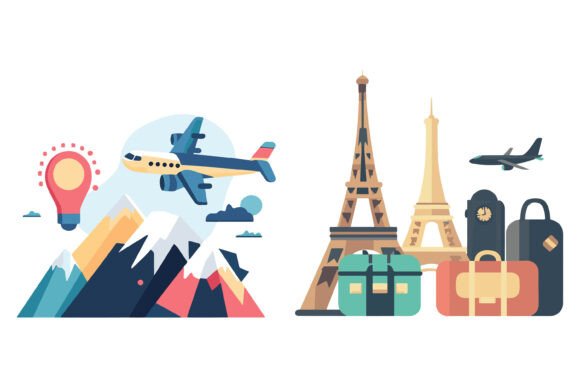
Tourist Agency Set: A Complete Guide to Professional Travel Illustration Resources
Every travel professional knows that first impressions shape customer decisions before a single word is read. When someone lands on your website, opens your brochure, or scrolls through your app, the visual language you use communicates trust, professionalism, and the promise of adventure. This is precisely where a thoughtfully designed Tourist Agency Set of illustrations becomes more than decorative—it becomes a strategic asset for your brand.
Whether you are running a boutique travel agency, designing materials for hospitality clients, or building the next great travel application, having access to a versatile illustration collection can transform how you present destinations, services, and itineraries. Let's explore what makes a dedicated travel-themed illustration set valuable, how to use it effectively, and what you should consider before integrating it into your creative workflow.
What Exactly Is a Tourist Agency Illustration Set
At its core, a Tourist Agency Set is a curated collection of vector illustrations specifically themed around travel, tourism, and hospitality. These sets typically include icons, characters, landmarks, transportation modes, and symbolic elements that visually represent the travel experience. The illustrations are created in formats like AI (Adobe Illustrator) and EPS (Encapsulated PostScript), which means they are scalable vector graphics that maintain crisp quality at any size.
What separates a specialized travel illustration collection from generic clip art is the intentional cohesion across every element. Imagine opening a folder and finding perfectly matched icons for airplanes, passports, suitcases, maps, hotel facades, beach umbrellas, hiking trails, and smiling travelers—all drawn with consistent line weights, color palettes, and artistic style. This harmony is what allows designers and business owners to build interfaces, marketing materials, and presentations that feel deliberately crafted rather than hastily assembled.
The Formats That Power Professional Workflows
Understanding the file types included in a quality illustration set helps you appreciate its flexibility. A well-organized Tourist Agency Set typically delivers content in multiple formats to serve different purposes:
- AI (Adobe Illustrator) — The native, fully editable source file where every shape, path, and color remains adjustable
- EPS (Encapsulated PostScript) — A universal vector format compatible with numerous design applications including CorelDRAW and Affinity Designer
- JPG (Joint Photographic Experts Group) — A flattened, raster preview or ready-to-use image for quick placement in presentations, social media, or web pages
This multi-format approach means you are not locked into a single software ecosystem. A designer working on a Mac can collaborate seamlessly with a Windows-based colleague, and both will find the files accessible and ready for their respective tools. The inclusion of JPG versions also supports non-designers who simply need high-quality imagery for immediate use without navigating complex editing software.
Who Actually Benefits from Travel Illustration Collections
The audience for a Tourist Agency Set extends far beyond travel agencies themselves. Let's consider the real people and projects that gain practical value from these resources.
Travel Agencies and Tour Operators
For traditional travel businesses, illustrations breathe life into service offerings. Rather than relying solely on stock photography—which can feel impersonal and overused—customizable vector art allows agencies to visualize multi-city tour packages, highlight seasonal promotions, and differentiate their brand identity. An illustration of a winding road through mountains, paired with icons representing included meals, guided tours, and accommodation, tells a richer story than text alone.
Independent Designers and Creative Studios
Freelance graphic designers and small creative agencies frequently handle projects across diverse industries. A comprehensive travel-themed illustration set becomes a reusable toolkit that speeds up client work for hotel branding, airline marketing, city tourism campaigns, or travel blog redesigns. Because the elements are editable, a designer can recolor icons to match brand guidelines, adjust line thickness for different contexts, and even deconstruct complex illustrations to extract individual components.
App Developers and UX Designers
Modern travel applications depend heavily on intuitive visual navigation. Consider a booking app that uses consistent, clear icons for flight search, hotel reservations, car rentals, and activity planning. A Tourist Agency Set provides these building blocks in a unified style, reducing the time spent sourcing individual icons from disparate libraries that may not visually align. Developers can implement the raster versions for lightweight loading while retaining vector originals for high-resolution displays and future updates.
Small Business Owners and Content Creators
Even solo entrepreneurs running travel vlogs, destination guides, or local experience businesses find value here. Having professional-grade illustrations readily available means newsletter headers, social media posts, and website sections can maintain visual quality without the recurring cost of stock photo subscriptions or custom illustration commissions. The ability to modify colors and compositions also allows for seasonal refreshes—think warm autumn tones for fall travel campaigns or bright, saturated hues for summer beach promotions.
Real-World Applications That Drive Engagement
The versatility of a Tourist Agency Set reveals itself through diverse practical uses. Here are scenarios where these illustrations become genuinely useful rather than merely decorative.
Building Trust Through Consistent Branding
Consider a regional tourism board launching a new campaign across print brochures, roadside billboards, mobile advertisements, and their official website. Using elements from the same illustration family across all these touchpoints creates subconscious recognition. Visitors who see a distinctive map icon on a flyer and then encounter the same visual language on the website feel a sense of familiarity and reliability. This consistency is difficult to achieve when pulling assets from multiple unrelated sources.
Simplifying Complex Travel Information
Travel inherently involves complexity—multiple destinations, varied transportation methods, accommodation tiers, seasonal considerations, and pricing structures. Illustrations serve as visual shorthand that reduces cognitive load for potential customers. An infographic showing a three-stop European tour becomes immediately scannable when airplane icons connect city illustrations, hotel symbols indicate overnight stays, and clock icons suggest duration. The viewer grasps the itinerary structure in seconds without parsing dense paragraphs of text.
Enhancing Digital Platforms and User Interfaces
Travel booking websites and mobile applications rely on clear wayfinding. A magnifying glass icon universally suggests search, but travel-specific interfaces benefit from specialized symbols—a passport for visa information, a stethoscope for travel insurance, a cocktail glass for dining and nightlife, or a compass for adventure tours. When these icons share identical stroke weights, corner radii, and proportions, the interface feels polished and professional rather than pieced together from free icon sites.
Enriching Educational and Training Materials
Travel and hospitality training programs use illustrated scenarios to teach customer service protocols, explain booking systems, or demonstrate cultural sensitivity practices. A Tourist Agency Set provides the visual assets to create engaging slide decks, handouts, and e-learning modules that hold learner attention better than text-heavy documents.
Evaluating Quality and Suitability for Your Projects
Not all illustration collections deliver equal value. When evaluating whether a particular Tourist Agency Set fits your needs, several factors deserve careful attention.
Organizational Structure and File Management
The behind-the-scenes organization of an illustration set dramatically impacts your efficiency. Consider whether files are logically named, grouped into clearly labeled folders, and structured with intelligible layers within each document. An illustration of a beach scene, for example, might separate background elements, foreground objects, and decorative details onto distinct layers. This thoughtful architecture allows you to isolate and repurpose individual components without hunting through hundreds of unnamed paths and shapes. Neat organization saves hours of frustration, especially when deadlines are tight and you need to locate specific assets quickly.
Cross-Platform Compatibility
Teams rarely work on identical hardware and software configurations. A set designed for both Mac and Windows users signals that the creator considered real-world production environments. Vector formats like AI and EPS inherently support cross-platform workflows, but consistent rendering across operating systems depends on how the files were originally constructed. Testing a few sample elements on your intended platform before committing to a full purchase is always a wise precaution.
Editability and Customization Potential
The true power of vector illustrations lies in their malleability. You should be able to change colors effortlessly—transforming a navy blue passport icon to forest green requires only a few clicks in a vector editing application. Similarly, you might need to resize elements for wildly different contexts: a tiny mobile menu icon versus a large billboard graphic. Vector formats handle this scaling without quality degradation, but the internal construction of the illustration determines how cleanly it adapts. Well-built illustrations maintain smooth curves and consistent stroke widths at any size because they rely on fundamental shape primitives and precise bezier curves rather than rough, complex compound paths that can break during editing.
Detail Consistency Across the Collection
Zoom into individual illustrations and compare them. Are stroke weights uniform? Do curves flow naturally? Are proportions balanced? A collection where every element looks like it belongs to the same family—rather than appearing as if ten different illustrators contributed pieces—provides the professional polish that elevates your final output. This consistency extends to the level of detail: simple icons should feel appropriately minimal, while more elaborate scene illustrations should balance complexity with clarity.
Versatility Across Mediums
Consider your output destinations. Print materials demand high resolution and CMYK color compatibility. Web and app interfaces require RGB color spaces, appropriate contrast ratios for accessibility, and file sizes that support fast loading. Infographics benefit from clear, communicative icons that remain legible at small sizes. A Tourist Agency Set suitable for all these applications provides flexibility that a single-medium collection cannot match. The ability to repurpose the same core assets across print collateral, digital platforms, presentation decks, and social media represents genuine value for teams managing comprehensive brand ecosystems.
Practical Considerations and Honest Limitations
While a dedicated travel illustration collection offers significant advantages, understanding its boundaries helps you set realistic expectations and make informed decisions.
First, recognize that any pre-made illustration set represents someone else's creative vision. The style—whether it leans toward flat minimalism, playful cartoon aesthetics, or sophisticated line art—may not perfectly align with your existing brand identity. Customization capabilities go far, but they cannot transform a fundamentally playful illustration style into corporate minimalism without extensive modification that may outweigh the time savings the set initially promised.
Second, consider the scope of included content. A Tourist Agency Set designed around general travel themes will likely cover common scenarios—beach vacations, city tours, mountain adventures, business travel—but niche offerings like ecotourism, culinary journeys, or specific cultural festivals may require supplemental sourcing or custom creation. Evaluate the collection's content against your actual project requirements rather than assuming comprehensive coverage of every possible travel scenario.
Third, remember that popular illustration sets used by many businesses across the same industry can lead to visual similarity across competing brands. If your travel agency uses the exact same widely-available icon set as three other local agencies, differentiation becomes harder. Consider how you might customize the illustrations—through color palette choices, composition arrangements, and combining elements in unique ways—to create distinctive results even from shared starting materials.
Making the Most of Your Illustration Investment
Once you have selected a suitable Tourist Agency Set, strategic implementation maximizes its value. Start by auditing your current visual assets and identifying gaps where illustrations could replace generic stock imagery or inconsistent iconography. Create a brand-specific color palette file that you can apply across the collection, ensuring every element integrates seamlessly with your existing identity.
Document your usage patterns by building a reference sheet showing which illustrations you have deployed and where. This simple practice prevents the accidental overuse of favorite elements and maintains variety across your materials. For team environments, share guidelines about illustration usage—appropriate sizes, color treatments, and pairing rules—so that everyone from graphic designers to social media managers maintains visual consistency.
Finally, revisit the collection periodically with fresh eyes. What looked like a simple passport stamp icon six months ago might inspire a new promotional concept today. The enduring value of a well-organized illustration library is that it grows alongside your creative capabilities, offering new possibilities as your skills and project needs evolve.
A Tourist Agency Set represents more than a folder of graphics. It is a foundation for visual storytelling in the travel industry—a toolkit that, when chosen thoughtfully and used creatively, helps you communicate the excitement, comfort, and wonder that travelers seek. Whether you are designing a mobile booking interface, laying out a destination brochure, or building an interactive travel planner, the right illustrations transform abstract travel concepts into tangible visual experiences that resonate with audiences and inspire action.