Set of Cherries: Evaluating a Flexible AI & EPS Illustration Collection
When a designer or creative team evaluates ready-made graphic assets, the first questions rarely revolve around visual appeal alone. File compatibility, layer organization, and the real-world flexibility of an illustration determine whether a resource sits unused on a hard drive or becomes a dependable part of daily output. The Set of Cherries illustration collection enters this space as a vector-based option that ships with AI, EPS, and JPG formats, targeting both Mac and Windows environments. Rather than simply offering a handful of cherry motifs, it presents a curated set of symbols and elements that can stretch across print, screen, app interfaces, and infographic compositions.
What’s Included in the Set of Cherries
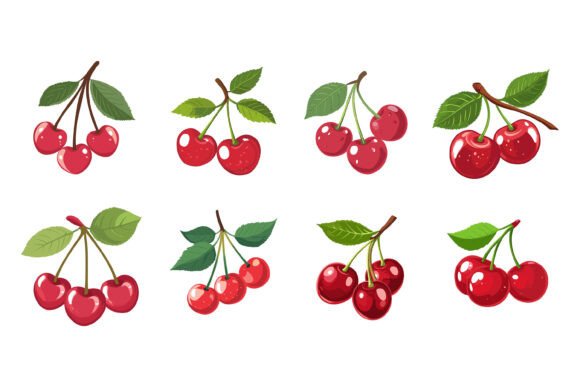
The package brings together multiple cherry-themed illustrations, each rendered with a consistent visual language. You’ll find whole cherries, clustered pairs, leaves, stems, and likely variations in angle and styling that make the group feel cohesive. Because the main deliverable includes Adobe Illustrator (AI) and Encapsulated PostScript (EPS) files, every object remains fully scalable without any loss of sharpness. A supplementary JPG version provides a quick preview or a raster fallback for situations where vector editing isn’t necessary.
From an immediate usability standpoint, this triple-format approach removes a common friction point. You aren’t locked into one software ecosystem. Mac users working in Illustrator or Affinity Designer will have native file access, while Windows-based designers using CorelDRAW or other EPS-compatible software can open the same illustrations without conversion headaches. The JPG file simply saves time during brainstorming or client presentations when a fast placeholder is enough.
File Structure and Technical Usability
Beyond file formats, how a set is organized inside the document matters a great deal. The Set of Cherries emphasizes a neatly arranged layer structure. In practice, this means that when you open the AI or EPS file, you’re likely to encounter separate layers for individual elements, grouped objects, and background components. A clean layer panel isn’t just a cosmetic nicety; it directly affects how quickly you can isolate a single cherry icon, hide the leaves, or extract an element for a navigation symbol.
Illustrators and UI designers who regularly pull assets from third-party collections will recognize the benefit immediately. Instead of spending minutes ungrouping nested clipping masks or hunting through dozens of unnamed layers, you can select the exact part you need. This level of organization also reduces the risk of accidentally breaking linked styles or gradient fills, preserving the integrity of the original artwork when you move pieces into new compositions.
Moreover, because the files are built for both Mac and Windows, cross-team collaboration doesn’t stumble on platform-specific quirks. A marketing manager on a PC can drop the EPS into a layout application, while a freelance illustrator on a Mac can dig deeper into the vector DNA of the illustrations to recolor or reshape entire objects.
Visual Quality and Consistency
Standalone attractiveness means little if the individual icons don’t work together. One of the noticeable strengths of this set is its attention to detail and internal consistency. Every cherry variation appears to have been crafted under the same lighting direction, stroke weight, and shading logic. That coherence becomes critical when you’re building an icon family for a recipe app, a wellness brand, or an infographic that repeats the cherry symbol across multiple data points.
The details—such as the subtle highlight on the fruit surface, the organic curve of the stem, or the vein structure on the leaf—suggest a level of refinement that stands up to close inspection. For print applications, where artwork might be scaled up to large poster sizes, imperfections would become immediately visible. The vector architecture of the Set of Cherries maintains crisp edges at any magnification, while the JPG preview gives you a reliable sense of how the artwork holds up in a pixel-based context.
That consistency extends to the color palette as well. Since the set is built with editable vector shapes, you aren’t forced to accept the default reds and greens. The original colors appear balanced and natural without drifting into overly saturated territory, but you retain full control to shift hues, lighten shadows, or match a brand’s specific primary palette.
Where This Set Performs Best
A well-made illustration pack shouldn’t be judged in a vacuum; its real worth becomes clear when you see the contexts it suits. The Set of Cherries fits particularly well into:
- Print materials: Menu designs, recipe booklets, packaging drafts, and promotional flyers can all benefit from high-resolution vector artwork that doesn’t pixelate when printed.
- Web and mobile interfaces: Tiny UI icons, onboarding screen spot illustrations, or category markers for food-related apps can leverage the simplicity and recognizability of the cherry motif.
- Infographics and data visualization: The clarity of the symbols makes them usable as repeating markers, chart embellishments, or legend entries where a consistent visual language helps viewers process information faster.
- Symbols and icon systems: Because each element exists on its own layer and can be separated in seconds, the set acts as a flexible icon library suitable for signage, wayfinding systems, or digital product badges.
This range isn’t automatic simply because the files are vectors; it stems from the deliberate design choices—clean outline silhouettes, a recognizable subject, and enough visual restraint that the cherries don’t overshadow the surrounding content.
Editing and Customization Depth
One of the more practical aspects often overlooked in product descriptions is how edit-friendly a file truly is. With the Set of Cherries, the claim that you can “change colors and modify the icon so easily” holds up upon inspection. Vector shapes inside the AI and EPS files are built with clearly separated paths. Fills, strokes, and gradient nodes are accessible without having to release complex compound masks. That accessibility means a designer with intermediate Illustrator skills can recolor the cherries to blue, reduce the stem opacity, or reform the leaf shape using standard anchor point editing.
Additionally, the ability to break apart grouped objects gives you compositional freedom. You might need only the leaf for a botanical diagram, or you might want to pair a single cherry with custom typography for a logo lockup. Because the originals come with a well-structured layer arrangement, you aren’t penalized for pulling the artwork apart. It’s a workflow that respects time: you can spend more minutes refining the design and fewer minutes deconstructing the asset.
Even for non-vector tasks, the presence of a JPG alternative lowers the barrier for quick mockups. A social media manager creating a post template doesn’t always need to launch a full vector editor; the ready raster image can serve as a placeholder that gets swapped out for the refined EPS after the design concept is approved.
Who Gains the Most from This Collection
The value of a niche illustration pack like the Set of Cherries is not universal, but it aligns strongly with several user profiles. Independent food bloggers and content creators who regularly publish recipe posts or nutrition guides will find ready-to-use visuals that don’t require custom illustration budgets. Small business owners in the gourmet, beverage, or organic produce space can use the cherries as part of their logo exploration, packaging mockups, or seasonal promotional graphics.
Design agencies and in-house marketing teams benefit when the consistency of the set supports multi-channel campaigns. If a campaign runs across social media, email newsletters, and printed brochures, having one well-organized source of cherry-themed graphics ensures the visual narrative doesn’t fracture. Educators and academic publishers producing materials on agriculture, botany, or health can embed the illustrations in PDFs or presentation decks without worrying about resolution limits.
Even serious hobbyists—such as crafters designing custom stickers, labels, or home décor templates—will appreciate the clean lines that translate well to cutting machines or screen printing processes. The layered architecture makes it straightforward to separate color plates or isolate outlines for specialized production techniques.
Considering Limitations and Trade-offs
A balanced evaluation requires looking at scenarios where the set might not be the ideal fit. The stylistic choices, while consistent, reflect a particular illustrative aesthetic. If a project demands ultra-realistic, photograph-mimicking renderings or a highly abstract geometric style, these cherries might feel out of place. The set works best when the intended design language leans toward clean, gently stylized vector illustration with a slightly polished finish.
Another consideration is the subject itself. The set focuses specifically on cherries, which makes it a highly targeted resource. That’s a strength if your needs revolve around fruit-themed graphics or food-related symbols, but it doesn’t offer a broad general-purpose icon library. Buyers looking for a massive, multi-theme bundle of unrelated objects will need to complement this collection with other assets. Additionally, while the JPG is handy, its raster nature limits resizing beyond its original dimensions; for large-scale prints, editors must always return to the vector source files.
Long-Term Value and Reusability
Digital design assets become more valuable when they can adapt to projects years after their initial download. The Set of Cherries positions itself as a long-lasting resource primarily because of the editable vector foundation. As brand guidelines shift, color trends evolve, or a new medium emerges, the core artwork can be recolored, reshaped, or repurposed without repurchasing. A cherry icon used in a 2024 mobile app can be restyled for a 2027 web redesign simply by tweaking the gradient and stroke thickness inside the same original file.
The cross-platform compatibility further extends that longevity. You aren’t tied to a subscription-dependent software version. Even as design tools update or change, the EPS format remains widely supported across operating systems and older applications, providing a stable safety net for archival purposes. Combined with the organized layer structure, this makes reusability more than marketing language—it becomes a practical asset management advantage.
For professionals and creative teams who evaluate purchases based on cost-per-use rather than upfront price, a well-built, easily editable vector set like this tends to pay for itself across a small handful of commercial projects. The time saved by avoiding from-scratch cherry illustrations or tricky image tracing alone can justify adding it to a resource library, especially when deadlines compress the design process.
In the end, the Set of Cherries doesn’t promise to revolutionize graphic design, but it offers what many experienced users actually look for: a thoughtful, cleanly built, and genuinely editable collection that slots into real workflows without unnecessary friction. Whether you’re assembling a polished infographic, refining a brand asset, or simply need a reliable cherry motif for a print layout, the combination of file types, structured organization, and visual consistency makes it a resource worth evaluating alongside your current toolkit.