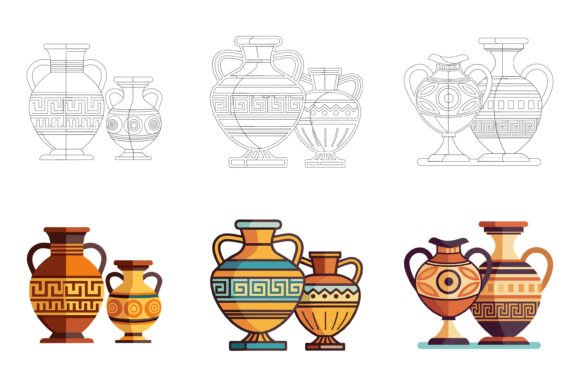
Antique Vases and Amphorae: Timeless Vector Illustrations
When a design calls for a sense of history, craftsmanship, or classical elegance, few visual elements carry as much weight as antique vases and amphorae. Their forms have been refined over centuries, appearing on ancient pottery, in Renaissance paintings, and across modern decorative arts. Today, having immediate access to professionally crafted vector illustrations of these objects changes the way creatives approach branding, editorial layouts, web graphics, and educational content. Rather than spending hours sourcing or sketching from scratch, you can work with a carefully organized AI EPS illustration set that balances authenticity with creative flexibility.
This collection offers more than just a handful of silhouettes. It delivers a suite of detailed, editable assets that fit seamlessly into Mac and Windows workflows, and it gives you the tools to adapt every line, curve, and color to your specific vision. The result is a resource that supports professional quality while respecting your time, making it easier to integrate classical motifs into contemporary projects without compromise.
What the AI EPS Illustration Set Contains
At its core, the package provides fully layered vector files in both Adobe Illustrator (AI) and Encapsulated PostScript (EPS) formats, along with high‑resolution JPG previews. The AI and EPS files preserve every path, fill, and stroke, so you can scale the vases and amphorae to billboard dimensions or reduce them to a mobile app icon without losing sharpness. The included JPGs let you drop a finished composition into a layout instantly, which is useful for quick mockups or for those who do not need to open a vector editing application.
Because the files are compatible with both macOS and Windows, you can move between different studio setups or share assets with colleagues without encountering format obstacles. This cross‑platform support is especially valuable in distributed teams where designers, marketers, and developers may be using different operating systems but need to work from the same visual library.
Why Antique Vases and Amphorae Resonate in Modern Design
Antique vases and amphorae carry a quiet authority. Their shapes are universally recognised, yet they leave enough room for interpretation that a designer can steer the narrative. A wine label might use a gently curved amphora to suggest Mediterranean origins and artisanal production. A museum’s app icon could feature a stylized vase to create an immediate link to cultural heritage. An editorial illustration about trade routes of the ancient world might animate an amphora as a symbol of exchange and abundance. Because these objects are not tied to a single era or region, they adapt easily to different themes—luxury, sustainability, hospitality, education—without feeling forced.
Having a cohesive set of such illustrations means you can build a consistent visual language. When every blog header, flyer, and social media graphic draws from the same well‑crafted library, audiences begin to associate that classical refinement with your brand or publication. This kind of visual consistency is difficult to achieve when you mix assets from scattered sources with varying styles and levels of detail.
Practical Benefits of an Organized File Structure
One of the most underrated aspects of a good vector collection is how the files are arranged. This set emphasizes a neat, logical folder and layer structure. Inside each AI file, you will find clearly named layers that separate outlines, fills, highlights, and shadows. If you have ever spent precious minutes hunting through dozens of unnamed paths, you know how much this clarity matters. It reduces friction and lets you concentrate on the creative decisions that actually move the project forward.
Effortless Customization of Colors and Details
Because the layers are kept distinct, changing the colour of a vase body while keeping the decorative band or rim intact takes only a few clicks. You might need to align the amphora with a brand palette that uses soft terracotta and deep indigo, or to create a monochromatic version for a black‑and‑white annual report. The ability to edit colours easily—and to modify individual elements like handles, neck patterns, or shadow shapes—means you are never stuck with a predetermined look. This level of control supports everything from subtle brand integration to bold, eye‑catching poster designs.
Consistency That Elevates Professional Presentation
When an illustration set is built with consistency in mind, every vase and amphora in the series shares the same line weight, shading style, and level of intricacy. That uniformity is essential when you place several objects side by side in an infographic, a timeline, or a product catalogue. Inconsistently styled assets can make a composition feel disjointed, even if the individual graphics are beautiful. Here, the attention to detail across the entire collection helps you present information with a confident, polished aesthetic that signals competence to clients, readers, or customers.
Who Gains the Most from These Antique Vase Illustrations
While any creative professional can benefit, certain groups find particularly strong alignment between the collection’s features and their daily work.
Graphic designers and brand specialists use the editable vectors to create logos, packaging, and promotional materials that require a timeless human touch. A craft distillery, for instance, could take an amphora outline and simplify it into a memorable mark that stands out on a busy shelf. Educators and content creators build engaging presentations, worksheets, and e‑learning modules where historical artefacts come to life without the risk of low‑resolution clip art. Bloggers and digital publishers who write about art history, travel, or archaeology find the JPGs ready to slot into article headers, adding depth and visual interest that keeps readers on the page longer. Small business owners and entrepreneurs without dedicated design teams can adapt the assets themselves, producing professional‑looking menus, labels, or social media posts without hiring outside help for every campaign.
Even hobbyists who craft personalised gifts, invitations, or scrapbook pages appreciate how the layered AI files let them isolate a single vase, add a meaningful inscription, and print it at home with crisp results. The cross‑platform nature of the files removes another barrier, making the collection accessible regardless of whether you work on a PC at the office and a Mac at your home studio.
Real‑World Applications That Go Beyond Theory
To understand the practical weight of having these assets at your fingertips, consider a few concrete scenarios. A cultural foundation is preparing an exhibition catalogue that traces the influence of ancient pottery on 19th‑century European design. The graphic designer drops a sequence of amphorae into the page margins, each tinted to match the chapter colour. Because the AI files are fully editable, the same silhouettes appear in a simple animation on the foundation’s website, where they drift behind the exhibition dates. There is no need to purchase a separate web‑specific asset; the vector scales perfectly for both print and screen.
In another case, a freelance infographic designer is commissioned to visualize the global olive oil trade. She uses the amphora illustrations as icon‑style markers for shipping routes, adjusting the orientation of each vessel to indicate direction. The organized layers let her quickly create a version where the amphorae are filled with a colour gradient that represents volume, and a second version where they are outlined for a cleaner black‑and‑white publication. The consistency of the set means she never has to worry that one icon appears more detailed than another.
A restaurant owner who wants to refresh his menu design downloads the collection, opens an EPS file in a free vector editor, recolours a decorative vase to a warm ochre, and places it as a subtle graphic behind the appetizer list. Because the files are easy to modify according to one’s needs, he completes the entire menu in an afternoon, saving the cost of a design consult and gaining a custom look that feels intentional rather than template‑driven.
Fit Considerations and When to Explore Further
No single resource fits every project perfectly. This collection shines when you need classical, well‑detailed representations of antique vases and amphorae that can be edited extensively. If your project instead calls for highly photo‑realistic 3D renders or historically precise museum artefacts with verified archaeological accuracy, you may need to complement these illustrations with additional references or custom photography. The strength of this set lies in its artistic, stylised vector approach—ideal for branding, modern editorial design, and creative infographics where suggestion and mood matter as much as strict realism.
Additionally, to unlock the full editing capability of the AI and EPS files, you will need compatible vector software such as Adobe Illustrator, Affinity Designer, or Inkscape. However, the included JPG files mean that even users who do not work with vectors can still enjoy high‑quality, ready‑to‑place images for digital and print projects. Simply dropping a JPG into a presentation or blog post can elevate the look immediately, and the scalable vector versions are there when you are ready to take customization further.
Making Antique Vases and Amphorae Part of Your Workflow
Integrating these illustrations into your daily work is straightforward. For print jobs, you can open the AI file, set your document to CMYK colour mode, and output to press with confidence that the paths will remain true. For web and app use, export as SVG or PNG at the required dimensions; because the source is vector, you can generate multiple sizes from a single master file without quality loss. The organized layer structure helps you quickly hide or show decorative details, letting you create bolder silhouette versions for symbols or app icons while retaining the richly detailed version for larger‑format prints.
If you are managing a brand asset library, consider adding the entire set to your shared folder with a simple naming convention. Because the files are already neatly organized, you can locate a specific vase form—wide‑mouthed, tall‑necked, twin‑handled—in seconds, even if you did not create the original naming scheme. This kind of practical edge becomes more noticeable as deadlines tighten and the number of assets you juggle grows.
A Resource Built for Your Creativity
Ultimately, what makes these AI EPS illustrations special is not any single technical feature but how thoughtfully the pieces come together to support your creative process. The combination of antique vases and amphorae, presented in clean, editable vectors with an orderly layer architecture, reduces the friction between your idea and a polished visual. You are not starting with a blank canvas or a poorly traced image; you are beginning with artifacts that already carry a sense of gravity and beauty, and you can reshape them to fit your exact context.
Whether you are designing a logo that tells a story, crafting an infographic that turns data into a narrative, or simply adding a touch of classical charm to a website banner, this collection offers a practical, dependable starting point. The flexibility to change colours, isolate elements, and output in both editable and universal formats means you can adapt it to both planned projects and last‑minute requests without a drop in quality.
When you weigh the time saved, the consistency achieved, and the professional result that a well‑curated vector set delivers, investing in a resource that aligns with your creative goals becomes a natural next step. Explore what these antique vase and amphora illustrations can bring to your work, and notice how quickly a simple classical silhouette can sharpen your entire design approach.