Popart Running Horse: A Versatile Illustration Asset for Modern Creative Workflows
Finding the right visual element to anchor a design project often takes longer than the actual layout work. The Popart Running Horse illustration set addresses this friction directly, offering a ready-made vector graphic that combines bold pop art aesthetics with the practical flexibility creative professionals need. Whether you're assembling a poster, refreshing a brand identity, or building an app interface, this illustration slides into your workflow without demanding hours of custom illustration work.
What makes this particular asset worth your attention isn't just the visual appeal—it's how the file structure, format choices, and editability align with the way designers, marketers, and business owners actually work. Let's walk through the practical side of integrating this illustration into your projects and why the technical decisions behind it matter more than you might expect.
Understanding the Popart Running Horse Illustration
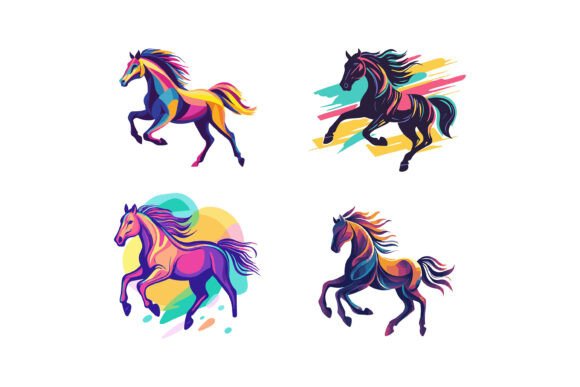
The Popart Running Horse captures motion and energy through the distinctive visual language of pop art—think bold outlines, vibrant color blocks, and a stylized approach that reads as both retro and contemporary. The running horse motif itself carries universal associations with freedom, speed, and forward momentum, which explains why it shows up across industries ranging from sports branding to motivational content to equestrian businesses.
But what separates a useful stock illustration from a frustrating one comes down to format and structure. This set delivers the artwork in AI and EPS vector formats, accompanied by a high-resolution JPG preview. If you've ever tried to scale a raster image for a billboard only to watch it pixelate into oblivion, you understand why vector files are non-negotiable for serious design work. The EPS format ensures compatibility across virtually every professional design application, while the native AI file preserves full editability in Adobe Illustrator.
Where the Popart Running Horse Fits Into a Design Process
Most creative projects follow a predictable rhythm: concept development, asset gathering, assembly and refinement, then output for various channels. The Popart Running Horse enters most naturally during the asset gathering phase, but its real value emerges as you move through refinement and final output.
During early project planning, having a well-organized illustration set means you can drop the horse graphic into mood boards, concept mockups, or client presentations without committing to a final color treatment. Because the files maintain separate, clearly labeled layers, you can present variations—a monochrome version for one direction, a full-color pop art treatment for another—all from the same source file.
As projects mature, the ability to change colors, modify shapes, and adapt the illustration to match brand guidelines becomes critical. A horse illustration that ships as a single flattened layer forces you into take-it-or-leave-it territory. The layered AI and EPS structure here means you can recolor the mane to match a brand palette, adjust stroke weights for different output sizes, or isolate specific elements for use as standalone icons.
Practical Compatibility Across Platforms and Users
The file set explicitly supports both Mac and Windows users, which matters more than a casual observer might think. Cross-platform compatibility issues still surface regularly in collaborative environments. A designer on a MacBook working in Illustrator and a marketing manager on a Windows PC opening the EPS in CorelDRAW both need the file to render identically. The EPS format serves as the common denominator that makes this possible, preserving vector data, color information, and layer structure regardless of operating system.
For professionals who work across multiple design tools—perhaps Illustrator for vector work, Photoshop for compositing, and InDesign for layout—the JPG preview provides a quick visual reference without launching a full vector editing session. This speeds up asset browsing and file management, particularly when you're digging through project folders weeks or months after the initial download.
Leveraging the Organized File and Layer Structure
Opening a downloaded illustration to find a chaotic mess of unnamed layers, ungrouped elements, and mysterious clipping masks is a special kind of frustration. The neatly organized file and layer structure promised by this collection isn't just a nice-to-have—it directly affects how quickly you can get to actual design work.
When layers carry descriptive names and logical grouping, you spend less time hunting for the specific element you need to edit. Want to change just the background color? Find the clearly labeled background layer. Need to adjust the horse's proportions? The illustration components are separated in ways that make individual element selection straightforward rather than a click-and-hope exercise.
This organizational approach also supports version control and iteration. If a client requests three color variations or asks you to remove a specific detail, well-structured layers let you toggle visibility, duplicate artboards, and export variations without rebuilding anything from scratch. The time savings compound significantly over the course of a project with multiple revision rounds.
Perfection in Details and Consistency
Consistency across design assets doesn't happen by accident. When an illustration set prioritizes perfection in details and consistency, it means someone has already done the painstaking work of ensuring stroke weights remain uniform, curves flow smoothly, anchor points are placed cleanly, and the overall aesthetic holds together at every scale.
This matters most when the Popart Running Horse needs to coexist with other design elements. Inconsistent line weights between different illustrations in the same project create visual friction that viewers pick up on even if they can't articulate why something feels off. A consistently crafted vector illustration integrates with your existing assets, typography, and layout elements without demanding corrective adjustments.
For print applications specifically, clean vector construction translates to sharp edges at any size. That pop art outline that looks crisp on a business card needs to hold up equally well on a trade show banner. Well-constructed vector art delivers this scalability without the designer having to rebuild or trace anything.
Multi-Context Suitability: Print, Web, Apps, and Infographics
The Popart Running Horse crosses context boundaries smoothly. In print applications, the vector format ensures output-ready quality for everything from stationery to large-format signage. CMYK color space compatibility means what you see on screen translates predictably to physical media, assuming proper color management practices.
For web and app interfaces, the illustration scales down to icon sizes while maintaining legibility—a genuine challenge for detailed illustrations that weren't constructed with small-scale viewing in mind. The bold pop art aesthetic actually works in its favor here, since strong outlines and high-contrast color blocking read well at reduced sizes where subtle gradients and fine detail would dissolve into visual noise.
In infographics and data visualization, the running horse can serve as a thematic anchor or category marker. Its dynamic posture naturally draws the eye and can guide viewers through sequential information. For presentations, the illustration adds personality to slides without the clip-art feel that generic stock imagery often brings.
Editability as a Time and Budget Saver
The ability to edit, change colors, and modify icons easily transforms a stock illustration from a one-time purchase into a reusable asset. A designer working on a seasonal campaign might tint the illustration warm oranges and reds for an autumn event, cool blues for a winter version, and vibrant primaries for a summer splash—all from the same source file.
This editability also serves brand consistency across different departments or team members. The social media manager pulling the illustration into a post template, the web designer placing it in a hero banner, and the print designer working it into a brochure can all start from the same approved file and adjust colors or crop as needed without creating inconsistent brand expressions.
For small business owners and freelancers who handle their own design work, easy editability means fewer hours spent wrestling with design software and more time focused on the actual messaging and strategy. The illustration becomes a flexible building block rather than a rigid, finished piece that dictates its own terms.
Integration With Broader Workflows and Tools
The Popart Running Horse doesn't exist in isolation—it lands in the middle of toolchains that include project management platforms, cloud storage, brand asset libraries, and collaboration tools. The file formats here integrate cleanly with this ecosystem.
AI and EPS files slot directly into Adobe Creative Cloud libraries for team sharing. They upload to cloud storage platforms like Dropbox or Google Drive without conversion or quality loss. They import into presentation software like PowerPoint or Keynote when exported to appropriate raster formats first. And they remain fully functional when opened in alternative vector editing applications like Affinity Designer or Inkscape, giving users outside the Adobe ecosystem a viable path to edit and use the illustration.
For agencies and studios with established design systems, the organized layer structure supports quick adaptation to component libraries and style guides. The illustration can be templated, duplicated, and batch-processed alongside other visual assets without requiring special handling or one-off workarounds.
Long-Term Usability and Asset Management
Investing in well-structured design assets pays dividends over time. The Popart Running Horse, properly filed in your asset library with clear naming conventions and metadata, remains usable years after download. When a future project calls for an energetic, stylized equestrian visual, you pull the file rather than starting a new search from scratch.
This long-term thinking benefits from a few practical habits. Rename the downloaded files to match your organizational system before filing them. Tag the files with relevant keywords in your asset manager. Consider creating a flattened preview version for quick browsing. And if you make significant modifications for a specific project, save the adapted version separately while preserving the clean original for future use cases that require a different treatment.
Making the Purchase Decision
The gap between seeing an illustration and actually using it in production comes down to practical considerations that the Popart Running Horse set addresses head-on. The combination of vector formats, cross-platform compatibility, organized layers, consistent detailing, and broad application suitability removes the friction points that often delay or derail design purchases.
For the professional evaluating whether this illustration belongs in their toolkit, the question isn't really about the visual appeal—that's apparent from the preview. The question is whether the technical implementation supports efficient, frustration-free use across the range of projects and outputs you actually handle. Based on the file structure, format choices, and editability baked into this set, the answer leans firmly toward practical, production-ready utility.