Mastering Visual Projects with a Set of Realistic Car Wheels
Imagine a graphic designer working late on a dealership's promotional flyer, or a UI artist fine‑tuning an automotive configurator app. In both scenarios, the quality of the car wheel graphic can make or break the final composition. A set of realistic car wheels isn't just a collection of images; it is a foundational resource that brings authenticity, depth, and detail to any vehicle‑related visual project. Whether you are creating a high‑impact infographic, a responsive website, or a large‑format print advertisement, the right illustration set saves hours of painstaking work while ensuring a professional finish.
For many creatives, the search for the perfect wheel asset ends when they discover a thoughtfully curated Ai EPS illustration set. These packs go far beyond simple clip‑art; they provide meticulously structured vector files that blend photorealism with complete editability. Let’s explore what makes such a collection indispensable, who benefits from it, and how its technical merits translate into real‑world efficiency.
Where Realistic Wheel Graphics Become Essential
The demand for high‑fidelity car wheel illustrations spans an impressive range of industries and applications. Understanding these use cases reveals why a well‑designed set is more than a decorative element — it becomes a strategic tool.
- Automotive Marketing and Print Collateral: Dealership brochures, posters, and magazine ads require wheels that catch the light exactly like real metal and rubber. A vector‑based set of realistic car wheels can be scaled to billboard size without losing a single crisp detail, and the separate rim, tire, and shadow layers let designers match exact brand colors.
- Web and App Interface Design: From car rental platforms to tire shop e‑commerce sites, interactive menus often need wheel icons that users instantly recognize. SVG‑ready files (exported easily from the included AI and EPS formats) integrate seamlessly into code, maintaining sharpness on retina displays.
- Infographics and Technical Diagrams: Illustrating brake systems, torque vectors, or tire wear patterns demands anatomical accuracy. With organized layers, an infographic specialist can isolate just the wheel’s cross‑section or highlight specific components without redrawing anything.
- Game and Simulation Prototyping: Indie game developers frequently use stylized yet realistic assets for vehicle selection screens or customization modules. A set of realistic car wheels pre‑built with consistent lighting and perspective angles accelerates asset pipelines dramatically.
- Social Media Content Creation: Automotive influencers and gearhead communities thrive on polished visuals. Customizable wheel graphics let creators drop a featured alloy into a branded template, tweak the colors to match a campaign, and post scroll‑stopping content within minutes.
The Anatomy of a Superior Illustration Collection
Not all graphic packs are created equal. The ones that truly speed up workflow and produce impeccable results share a set of defining characteristics. When you evaluate a resource — perhaps one labeled Hello Welcome to our Special AI EPS Collections — look past the surface and examine the structure beneath.
Uncompromising Detail and Consistency
A hallmark of professional‑grade assets is perfection in details and consistency. Every spoke, nut, and tire tread in the collection should exhibit the same level of photorealism and lighting direction. This uniformity allows you to place multiple wheel variations side‑by‑side in a product catalog without a jarring stylistic mismatch. The subtle reflections on chrome, the depth of the rubber tread grooves, and the nuanced shadows give each illustration a tangible, three‑dimensional presence that flat icons simply cannot match.
Intelligent File Organization
Time is money, and hunting through poorly named layers kills momentum. A thoughtfully built Ai EPS collection includes neatly organized file and layer structure. You might find logically named groups — such as “Rim,” “Tire,” “Brake Caliper,” “Highlights,” and “Shadow” — which make it trivial to swap a sporty multi‑spoke design for a classic steel wheel. Even better, when the set arrives with both AI (Adobe Illustrator) and EPS (Encapsulated PostScript) formats, plus a high‑resolution JPG preview, you gain immediate compatibility across nearly every software ecosystem.
Cross‑Platform and Multi‑Format Flexibility
Modern design teams rarely work in isolation on a single operating system. A robust illustration pack explicitly states it is designed for Mac and Windows users. The AI file retains full Illustrator editability, while the EPS serves as a universal vector exchange format for CorelDRAW, Affinity Designer, and even presentation tools like PowerPoint. The bundled JPG gives a quick reference or an instant web‑ready image when full editing isn’t required. This format trio eliminates conversion headaches and keeps the workflow fluid regardless of the hardware on your desk.
Practical Customization: More Than Just Changing Colors
The phrase “you can edit it, change colors and modify the icon so easily” might sound like stock language, but in practice it translates into genuine creative freedom. Because the wheel components reside on separate layers, a designer can accomplish tasks that would be impossible with a flat raster image:
- Recoloring Alloy Finishes: Transform a silver rim into a matte black, bronze, or anodized red with just a few clicks in the vector editing workspace. Individual gradient meshes and highlight paths adjust instantly to the new palette.
- Swapping Tire Profiles: Need a low‑profile performance tire instead of an all‑terrain tread? If the set includes multiple tire styles on distinct layers, you simply toggle visibility or replace a linked graphic. The integrity of the composite image remains flawless.
- Integrating Brand Logos: Center caps are prime real estate for company marks. A single editable artboard allows you to drop a client’s logo into the hub area and apply the same metallic bevel, shadow, and reflection treatments already used throughout the illustration.
- Creating Alternate Perspectives: While some collections focus on a perfect side profile, others include subtle angled views or isometric projections. By grouping and transforming the base artwork, you can adapt a given wheel to match different vehicle body shots, maintaining the intricate spoke details even at odd perspectives.
The Workflow Advantage for Busy Professionals
Consider a typical Monday morning: a marketing manager needs a hero image for a “September Tire Sale” landing page, and the photographer is backlogged. Instead of waiting, you pull up a JPG from the set of realistic car wheels to mock up the layout instantly, then refine it with the AI file to exactly match the rims being promoted. Because the graphic is suitable for print, web, symbols, apps, and infographics, the same wheel asset can shrink to a 32×32 pixel favicon for the browser tab, reside in an email blast, and stretch across a vinyl banner — all from a single master file. This reuse eliminates the fragmentation of maintaining multiple versions in different resolutions and reduces the risk of outdated graphics lingering in the asset library.
For UI/UX designers working on an automotive marketplace app, the symbolic clarity of a well‑drawn wheel icon helps users filter search results by vehicle type, rim size, or tire condition. The vector source files allow the icon to be programmatically tinted to indicate availability — green for in‑stock, gray for out‑of‑stock — without any loss of legibility. Moreover, because the original art is constructed with precise anchor points and minimal superfluous nodes, the exported SVG code stays lean, contributing to faster page loads and better SEO performance for the app’s landing pages.
Choosing the Right Collection for Your Toolkit
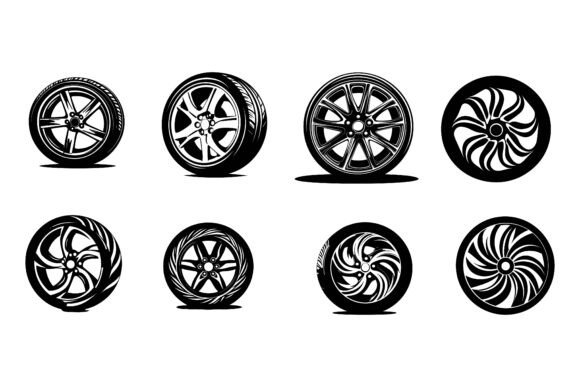
When investing in a digital illustration resource, discerning buyers look beyond the cover image. They examine the set of realistic car wheels for variety — does it include classic five‑spoke designs, modern turbine styles, and rugged off‑road options? They verify that the file architecture truly includes separate editable elements, not just a single flattened group. They check whether the light source remains consistent so that mixing and matching wheels from the same set won’t produce unrealistic composite scenes.
The most reputable collections also respect the fact that design trends evolve. Today’s projects might demand hyper‑realism, but tomorrow’s brief could call for a simplified, app‑icon style. Because vector artwork is inherently resolution‑independent and style‑agnostic in its base construction, you can apply graphic styles, pathfinders, and distortion effects to morph a photorealistic rim into a clean, minimalist symbol — all within the same familiar Illustrator environment. This adaptability future‑proofs your purchase and extends the value of each illustration far beyond its initial application.
Beyond the Pixel: The Intersection of Art and Engineering
At first glance, a wheel seems like a simple circular object. In reality, accurately depicting a car wheel requires an almost engineering‑like attention to geometry. The spoke curvature, the conical angle of the lug nuts, the way rubber deforms visually under load — these subtleties separate a convincing illustration from a generic cartoon. The creators of a top‑tier Ai EPS illustration set often study actual wheel designs, referencing OEM specifications and real‑world lighting to build assets that satisfy both artistic and commercial scrutiny.
This depth of knowledge becomes apparent when you zoom into the artwork at 400% and see crisp, intentional vector paths rather than messy bitmap traces. Layers named “Rim Flange Highlight” or “Tire Sidewall Text Bump” indicate a methodical building process. For an instructional designer developing a training module on tire safety, such granularity means they can easily isolate and annotate the sidewall area, adding callouts without the underlying graphic fighting for attention. For a motion graphics artist, the structured layering serves as a ready‑made storyboard for animated reveals — spinning the wheel, highlighting the brake disc, and so on.
The message is clear: a set of realistic car wheels in editable vector format is not a static product — it is a creative platform. Whether you are swapping out hues for a seasonal campaign, scaling an asset to fit a massive tradeshow backdrop, or embedding an icon into a mobile interface, the combination of realism and flexibility empowers you to deliver visually consistent, technically flawless work. It stands at the crossroads of aesthetic fidelity and production pragmatism, ready for whatever brief lands on your desk next.