Evaluating Bath Time Outline Icons for Professional Design Workflows
Finding the right visual assets can quietly determine how smoothly a project moves from concept to completion. Designers, marketers, and content creators often spend more time than they expect searching for icon sets that meet both creative and technical requirements. The Bath Time Outline Icons collection enters this space as a focused resource built around a specific yet broadly applicable theme. Rather than chasing trends, the set emphasizes clean minimalism, wide format compatibility, and straightforward customization. What follows is a practical look at how these icons perform, where they fit into real projects, and who stands to gain the most from adding them to a creative toolkit.
What the Bath Time Outline Icons Collection Actually Offers
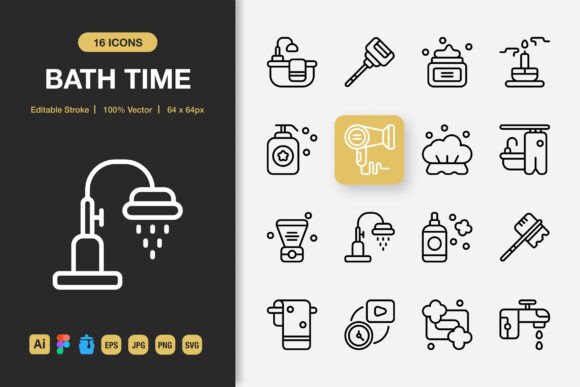
At its core, this is a curated set of outline-style icons centered on bathing, self-care, hygiene, and relaxation themes. The icons use a consistent stroke-based aesthetic that reads clearly at multiple sizes. This matters because outline icons often function as supporting visual elements rather than focal points. They need to communicate quickly without competing for attention. The set includes one hundred individual icons, each designed with editable stroke properties that let users adjust thickness, color, and styling without degrading quality.
The collection ships across multiple file formats, which immediately signals an awareness of how fragmented modern design toolchains can be. You receive the source Adobe Illustrator file for deep editing, a Figma file for collaborative and UI-focused work, and an Iconjar file for teams that manage icon libraries through dedicated organization tools. Beyond these source formats, the package includes EPS Version 10 for broad vector compatibility, SVG files for web and development use, PNG files with transparency for quick placement, and JPG files for scenarios where raster formats are still required. A readme file rounds out the delivery with documentation. This format selection covers the vast majority of professional use cases without demanding format conversion work on the user's end.
Design Consistency and Visual Language
Outline icons succeed or fail based on the uniformity of their line work. When one icon in a set uses a 2-pixel stroke and another uses a 3-pixel stroke, the inconsistency becomes visible immediately in application. The Bath Time Outline Icons maintain a deliberate consistency across all one hundred icons. The line weights match, the corner rounding follows predictable rules, and the level of detail stays balanced from simpler icons like a single soap bar to slightly more complex ones like a bathtub with surrounding elements.
This consistency is not just about aesthetics. It reduces the need for manual adjustments when icons sit next to each other in navigation menus, feature lists, or infographic sequences. A designer can place a shampoo bottle icon beside a towel icon and trust that they will feel like they belong to the same family. The minimalist approach also means the icons age well. Heavily stylized or overly detailed icon sets can look dated after a few years. Outline icons with clean geometry tend to remain usable across design cycles, making this a resource with genuine shelf life.
The subject coverage within the bathing theme is practical. You will find icons for bathtubs, showers, soap, shampoo, towels, robes, rubber ducks, sponges, lotion bottles, candles, bath salts, and several other related objects. The range is broad enough to support varied content without stretching the theme beyond recognition. A wellness blog could use these alongside articles about self-care routines. A mobile app for a spa booking service could incorporate them into navigation and onboarding screens. An e-commerce site selling bath products could deploy them in category pages or feature callouts.
File Format Depth and What It Means for Workflow
One of the more pragmatic strengths of this icon set is the deliberate inclusion of source files and multiple vector formats. The Adobe Illustrator file serves as the master editable document. For teams or individuals who work primarily in the Adobe ecosystem, this is the most direct path to customization. You can open the file, adjust stroke weights globally if needed, recolor entire sets in a few clicks, and export targeted subsets for specific projects.
The inclusion of a Figma file acknowledges the shift toward browser-based collaborative design. UI and UX designers who live in Figma can pull these icons directly into their component libraries without running intermediary conversion steps. This saves real time on projects where design systems need to scale. The Iconjar file is a less common but genuinely useful addition for teams that manage large volumes of icons. Iconjar allows tagging, searching, and drag-and-drop export of icons, which becomes valuable when a brand or agency accumulates multiple icon sets over time and needs to locate specific visuals quickly.
On the web development side, SVG files are the modern standard for resolution-independent icon display. The SVGs in this collection are clean and lightweight, making them suitable for inline use in HTML or as external assets loaded through an icon system. PNG files with transparency offer a fallback for environments where SVG support is limited or where raster placement is simply faster. EPS and JPG formats round out compatibility for print workflows and legacy systems. This format breadth means the Bath Time Outline Icons do not lock you into a single tool or output medium.
Customization Potential Without Design Overhead
Customizability is one of the listed features, and it is worth examining how that plays out in practice. Because the icons are built with editable strokes rather than expanded filled shapes, users can change the fundamental appearance without reconstructing paths. You can increase or decrease stroke weight to match brand guidelines. You can change the stroke color to any hex value or apply gradient strokes in software that supports them. The outlined nature also means the icons can be placed on photographs, colored backgrounds, or dark surfaces without requiring a containing shape or background treatment.
For non-designers or those who need to move quickly, the drag-and-drop readiness of the PNG and SVG files removes friction. A social media manager creating a post about a bath product line could pull an icon directly onto a canvas without adjustment. A blogger writing about relaxation techniques could insert icons into article headers or callout boxes with minimal effort. The icons are designed to work immediately while still offering depth for those who want to modify them.
Practical Applications Across Media Types
The stated suitability of this icon set spans websites, mobile apps, books, social media, infographics, flyers, print materials, banners, and posters. This is not an exaggeration. Outline icons of this style adapt well across mediums because their simplicity translates cleanly. On a website, they can serve as category indicators, feature highlights, or UI elements. In a mobile app, they work as tab bar icons, list item decorations, or onboarding illustrations when paired with supporting content. Printed materials like brochures or product catalogs benefit from the clean vector lines that reproduce sharply at any scale.
Social media applications deserve particular attention. Platforms favor content that is visually organized and scannable. Adding a small, relevant outline icon to a text-heavy infographic or carousel slide can break up information and guide the viewer's eye. The bathing and self-care theme maps naturally onto content about wellness, mental health, parenting young children, beauty routines, and relaxation tips. A content creator in the wellness niche could build a recognizable visual language around these icons, using them consistently across posts to strengthen brand identity.
Books and educational materials represent a less obvious but valid use case. Illustrations in instructional content about hygiene, childcare, or health topics often benefit from simple, non-distracting visuals. The outline style of these icons keeps the focus on the information while providing enough visual cue to support comprehension. The editable nature means publishers can adjust the icons to match the book's interior design without commissioning custom illustrations for every small visual element.
Who Benefits Most from This Icon Set
Several distinct user groups will find the Bath Time Outline Icons particularly useful. Web and app designers working on projects in the wellness, beauty, or lifestyle sectors can use these icons to accelerate interface design without sacrificing visual quality. The Figma file and SVG output align directly with common UI workflows. Content creators and bloggers who write about self-care, parenting, or home life will appreciate having a cohesive visual toolkit that does not require design software expertise to deploy. The PNG files with transparency can be dropped into Canva, Google Slides, or similar tools with no learning curve.
Small business owners selling bath products, soaps, candles, or spa services can use the icons across their marketing materials to create a consistent look. A skincare brand could use the same icon set on their website, product packaging mockups, social media templates, and email newsletters. This kind of visual consistency builds brand recognition without the cost of custom icon design. Educators and publishers creating materials about health, hygiene, or early childhood topics will find the icons useful for worksheets, presentations, and instructional guides. The straightforward style works across age groups and does not feel childish or overly corporate.
Evaluating Quality and Long-Term Value
Quality in icon design is measured by more than just how the icons look at first glance. Technical construction matters. Poorly built icons can contain unnecessary anchor points, open paths, or inconsistent scaling behavior that causes problems down the line. The Bath Time Outline Icons appear to be constructed with attention to clean vector craftsmanship. The stroke-based approach means the files are inherently simpler than filled illustration styles, which contributes to smaller file sizes and easier editing.
The long-term value of an icon set often comes down to reusability. A niche icon set that only applies to one project has limited value. A versatile set with a flexible theme can be revisited across multiple projects over several years. The bathing and self-care theme is specific enough to be relevant to targeted industries yet universal enough that many different types of content can incorporate it. The minimalist outline style also means the icons will not feel dated as design trends shift, because simplicity tends to outlast ornamentation.
Having one hundred icons in the set provides enough variety to cover most sub-topics within the theme without becoming bloated. Too few icons and the set feels incomplete. Too many and quality can suffer as designers stretch to fill a number. One hundred is a balanced count for a themed collection, offering breadth without dilution.
Potential Limitations and Considerations
No design resource is universally perfect, and honest evaluation requires acknowledging where something may not fit. The outline style, while versatile, may not suit projects that require filled, solid, or highly detailed iconography. A brand that uses bold, heavy visual elements might find these icons too delicate for their established aesthetic. In those cases, the editable stroke feature can help by increasing line weight, but the fundamental outline character remains.
The theme is also inherently specific. If your project does not relate to bathing, hygiene, self-care, or relaxation in any way, the icon set will have limited application. This is not a general-purpose icon library. It serves a defined niche well, but users should verify that the theme aligns with their content before purchasing. The JPG format inclusion, while a nice extra, is less useful for professional design work given the availability of PNG and SVG alternatives with better transparency and scalability.
Users who work exclusively in tools that do not open Adobe Illustrator or Figma files will still find value in the SVG, PNG, and EPS formats, but they may not access the deepest customization layer without converting files or finding compatible software. This is a minor friction point rather than a genuine barrier, since vector editing is possible with many free and paid tools that support SVG or EPS import.
Making the Decision
Choosing an icon set should be driven by how well it fits the projects you actually work on. The Bath Time Outline Icons collection makes sense for anyone whose content touches bathing, wellness, self-care, or related lifestyle topics and who values clean, consistent, minimally styled visuals. The format support removes technical obstacles. The editable construction respects the need for customization. The quantity of icons provides meaningful coverage of the theme.
For designers building a reusable asset library, this set slots in as a reliable thematic resource that will not require constant maintenance or replacement. For content creators and business owners, it offers a way to elevate visual communication without design overhead. The absence of exaggerated styling keeps the focus on clarity and function, which is ultimately what good icon design accomplishes. Whether these icons end up in a mobile app, a printed flyer, or a social media graphic, their consistent construction and broad compatibility make them a practical addition to a working creative toolkit.